
Official Announcement or Forwarded Rumour? How to Check the Source of a Casino Update
Introduction
A casino update can spread through group chats and reposts before anyone checks who published it. When a name such as Rajbet appears, the key question is not how often the message has been shared, but whether it can be traced to a reliable source.
There is no specific notice, date or original post to assess here, so it would be irresponsible to label any particular update genuine or false. A confident headline is not proof, and a screenshot without context cannot show who wrote the message, when it appeared or whether it is still current.
The distinction matters. An official announcement has an identifiable publisher and a verifiable publication date. A forwarded rumour may repeat accurate information, but repetition does not authenticate it. The task is to separate what the message claims from what the evidence supports.
Who is involved
No sports teams or players are mentioned in the available information, and inventing them would distract from the issue. The relevant parties are the source said to have issued the update, the accounts that shared it and the readers being asked to accept it as fact.
The first is the claimed source: a casino’s official website, a verified account, a named representative or another channel that can be independently linked to the organisation. A name or logo on an image is not enough. Check the account address, its publication history and whether it is linked from the organisation’s own channels.
The second is the network sharing the message. People may pass on a notice in good faith, but each copy can lose the original date, author and context. A message shared by several familiar contacts may seem well supported, even if every copy leads back to the same unverified post.
The third is the publisher or analyst deciding what can be reported. Their role is not to fill gaps with plausible details, but to make them clear. If the original source cannot be found, the accurate description is that the claim is circulating and remains unverified—not that the casino has announced it.
Key factors
Start by checking the source. Find the earliest available version of the notice and see whether it appeared on a channel controlled by the organisation. A direct link to an official page is stronger evidence than a screenshot, but make sure it leads to the claimed publisher, not a lookalike page or an unrelated repost.
Next, check the date and wording. Updates may be shared long after publication, and a genuine notice can be paraphrased in a way that changes its meaning. What one version calls confirmed might be described in the original as proposed, temporary or conditional.
Then look for independent confirmation, not just more copies. Several accounts repeating the same sentence are not separate sources if they all trace back to one post. Stronger corroboration comes from distinct, accountable channels that make the same claim or refer to the same primary document.
Be cautious with images. Logos, polished graphics and familiar colours can be copied. They may show what a message is trying to imitate, but they do not prove who made it. A cropped image may also hide a disclaimer, an earlier date or a link that changes how the announcement should be understood.
Finally, consider what evidence would resolve the question. A dated statement on an official channel, a working link from the organisation’s own site or confirmation from an identified representative can establish the claim. If none is available, preserve the uncertainty rather than turning it into certainty for the sake of a stronger headline.
Scenario: how the claim plays out
Imagine a forwarded image announcing a change to a casino service. It carries a logo and uses decisive wording, but shows no date or link. The change should not be reported as fact until someone checks whether an original notice exists and whether the image matches it.
If the image leads to a dated statement on an official channel, the claim can be reported with that source and any relevant limitations. The wording still matters: a planned change is not proof that it has taken effect, and a notice about one service should not be applied to others.
If no primary source can be found, the message can be described as circulating, with its status clearly unresolved. Its claims should not be presented as an official announcement. A lack of confirmation does not prove the message false; it means there is not enough evidence to treat it as true.
There may also be a middle ground: an authentic post exists, but its date or scope is unclear. In that case, explain precisely what has been verified and what remains uncertain. This may be less dramatic than a definitive claim, but it gives readers a more reliable account.
Conclusion
A casino update should not be judged by whether it sounds plausible, looks professionally designed or has reached a large audience. The key is whether it can be traced to an authoritative source, and whether the original wording and date support the version now being shared.
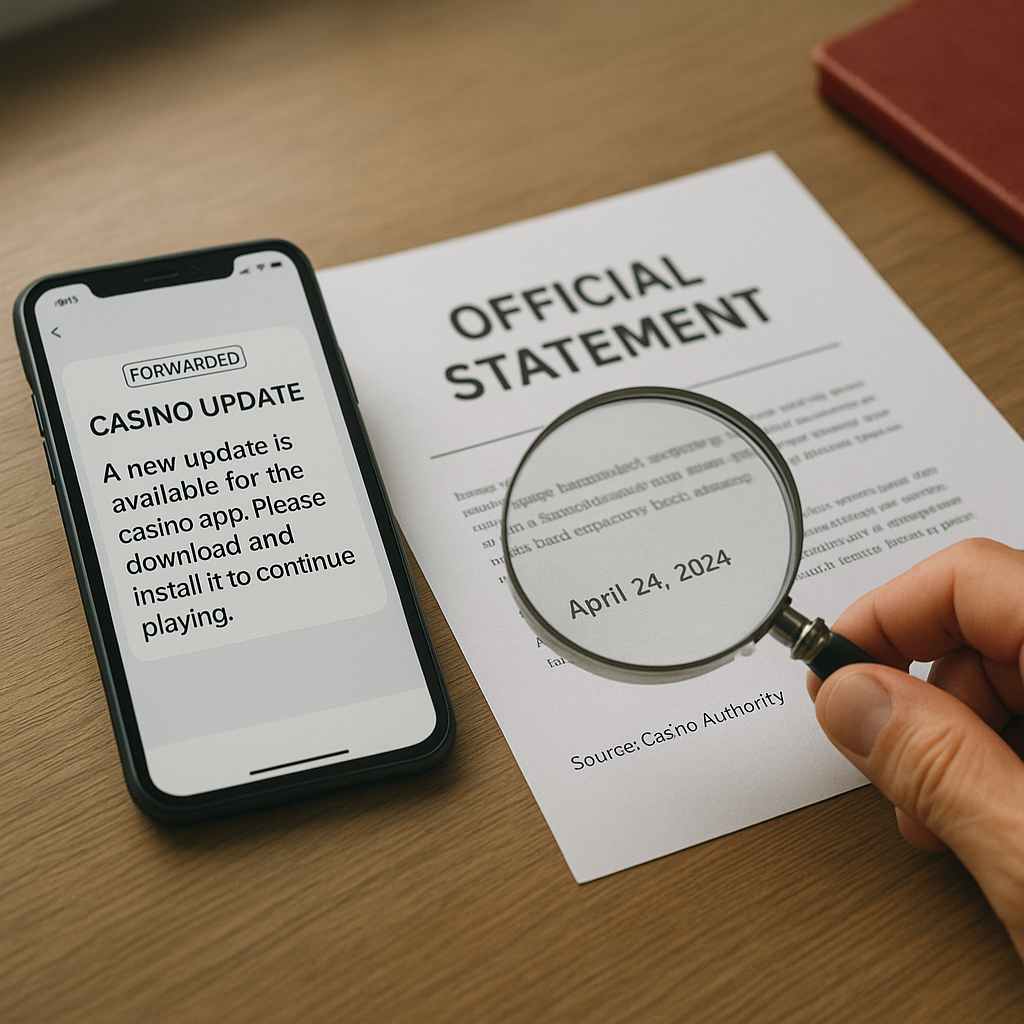
Without a specific notice or verifiable source, the verdict must remain open. That is not a failure to report; it is the difference between documenting a rumour and confirming an announcement. In a fast-moving chain of information, accuracy starts with keeping the two separate.